A bill of materials that updates when the drawing does
Nobody re-types it: the model is the take-off, and the quantities move when it moves.
Try it with a sample plant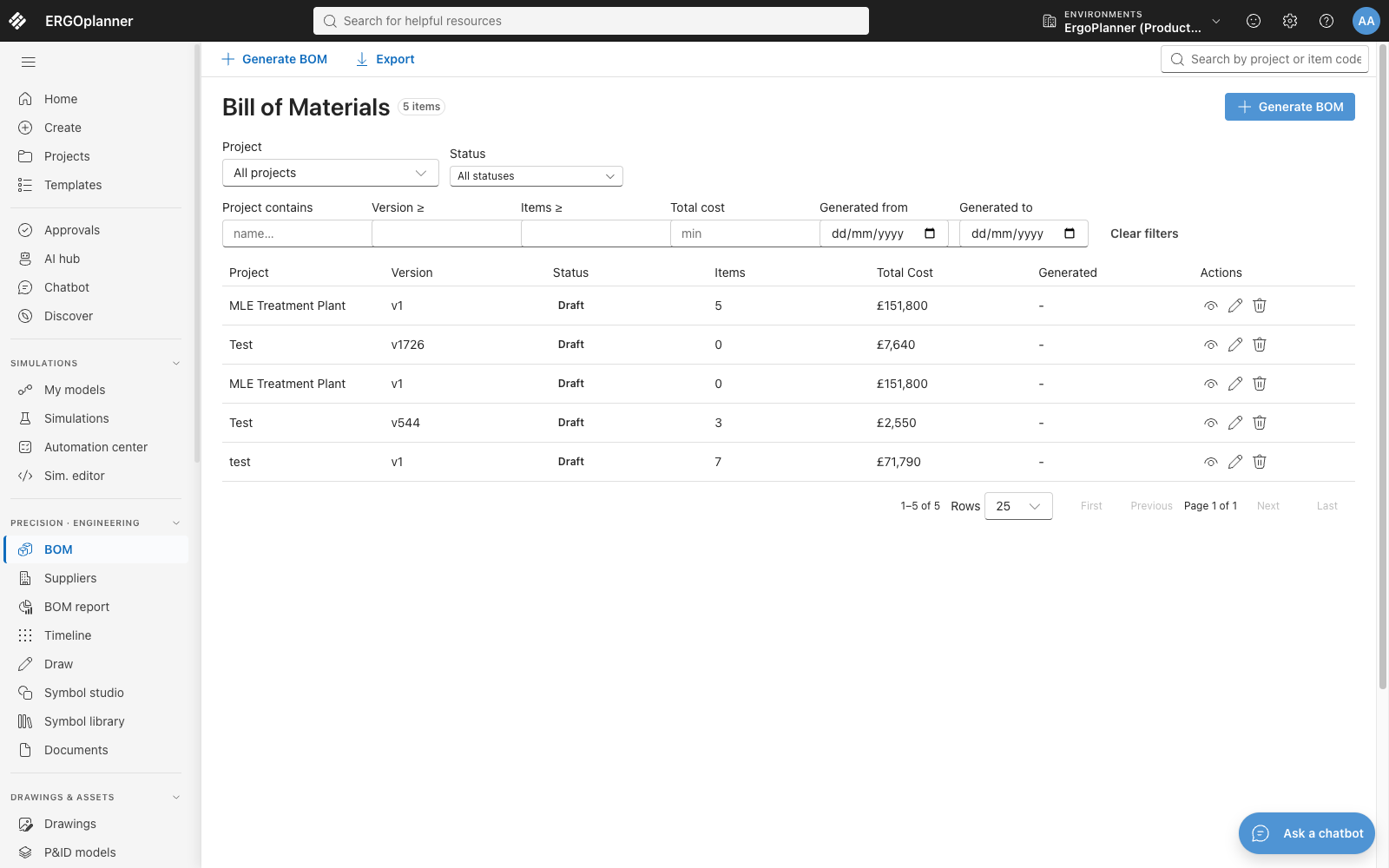
What this replaces
The take-off is done by hand, off a PDF, by whoever has the afternoon
The quantities are out of date the day the drawing is issued, because the drawing moved and the spreadsheet did not
The number you quote from lives in a file nobody owns and nobody can trace back to a symbol
How it works
What you get out
- Bill of quantities as XLSX — line items on one sheet, category summary on another
- Bill of quantities as PDF, with the project and drawing in the title block
- CSV, through the BoQ agent (Professional plan and an AI provider key)
- Costed lines — unit cost, total cost and the rate card the rate came from
- A lead-time procurement schedule, through the same agent
- A diff between two versions of a bill, through the same agent
- Purchase, installation, inspection, maintenance, replacement and decommissioning events per line
The bill is derived from what is in the model: it is only as complete as the drawing, and it is a take-off for a competent engineer or quantity surveyor to check, not a priced order.
What it is built to
- Every line traces to the symbol it came from, by source symbol id and tag
- Rates resolve project → company → shared catalogue, from the most specific card that carries one
- A quantity override is put through your own governance rules first — held for review, or refused outright
- Generation is deterministic code with no language model in the path — the same model produces the same bill
Technical capabilities
Questions people actually ask
How fast does the bill follow the drawing?
About thirty seconds behind your last save, because the save trigger is debounced by that much. It is not live to the keystroke, and we would rather give you the number than say "instantly".
Where do the quantities come from?
From the elements in the model and the catalogue material each one maps to. Nothing is typed into the bill by hand, so a quantity that looks wrong is a question about the drawing, which is usually the faster thing to fix anyway.
Are the costs real?
They are as real as the rate card behind them. Rates resolve from your project card, then your company card, then the shared catalogue, and a quantity override goes through the governance rules you set before it sticks. We supply the arithmetic and the trail; you supply the rates.
Can it raise a purchase order?
No. It produces the bill, the costs and a lead-time schedule, and you take those into whatever you buy through. There is no integration with a procurement system today.
Does it need an AI plan?
Not for the bill itself — generation, costing and the XLSX and PDF exports are deterministic code on every plan. The CSV export, the lead-time schedule and the version-to-version diff run through the BoQ agent, which needs a Professional plan and an AI provider key.