Who builds this P&ID software, and how
The engineering behind it, and the gaps we name rather than hide.
We would rather be judged on this than on a photograph. Every method below is implemented, named, and demonstrable without an AI key or a paid plan.
| Standard or method | Where it lives |
|---|---|
| IEC 61508-6 — SIL verification, simplified low-demand PFDavg | Functional-safety module |
| IEC 61511 Annex F — LOPA frequency maths and the IPL independence gate | LOPA studies |
| IEC 60079-10-1 and DSEAR 2002 — zone classification, by a simplified scheme | DSEAR assessments |
| IEC 61882 — the HAZOP guide-word set and the 5×5 risk matrix | HAZOP worksheets |
| ASM1, ASM2d, ASM3, ADM1 and Anammox biokinetics | Process simulation |
| Takács double-exponential settling | Secondary clarifiers |
| Todini–Pilati global gradient algorithm | Hydraulic network solver |
| BS 1553, ISA-5.1, ISO 10628, PIP and IEC symbol standards | Symbol library — 2,660 symbols |
| PostgreSQL row-level security, enabled and forced, on the tenant tables | Multi-tenancy |
What this is, and who it is for
The short version: engineering software for people who have to live with a drawing after it has been issued.
- ErgoPlanner is a P&ID editor built on a structured model rather than on a drawing file. An element carries its own identity, tag and attributes, and a connection knows its direction — which is what lets a bill of materials be derived from the drawing instead of typed beside it.
- Its deepest ground is municipal water and wastewater. The unit library, the biokinetic models and the design-criteria packs are for treatment processes, and the simulation half of the product is not a general-purpose process simulator.
- The safety and calculation work is deterministic code, not a language model. HAZOP guideword analysis, SIL, LOPA, FMEA, DSEAR, mass balances and the hydraulic solver all run with no AI provider configured at all.
- The drawing editor needs a browser with WebGPU, and there is no fallback renderer. On a browser without it you see a message instead of a canvas — worth knowing before you plan a demo on a locked-down corporate desktop.
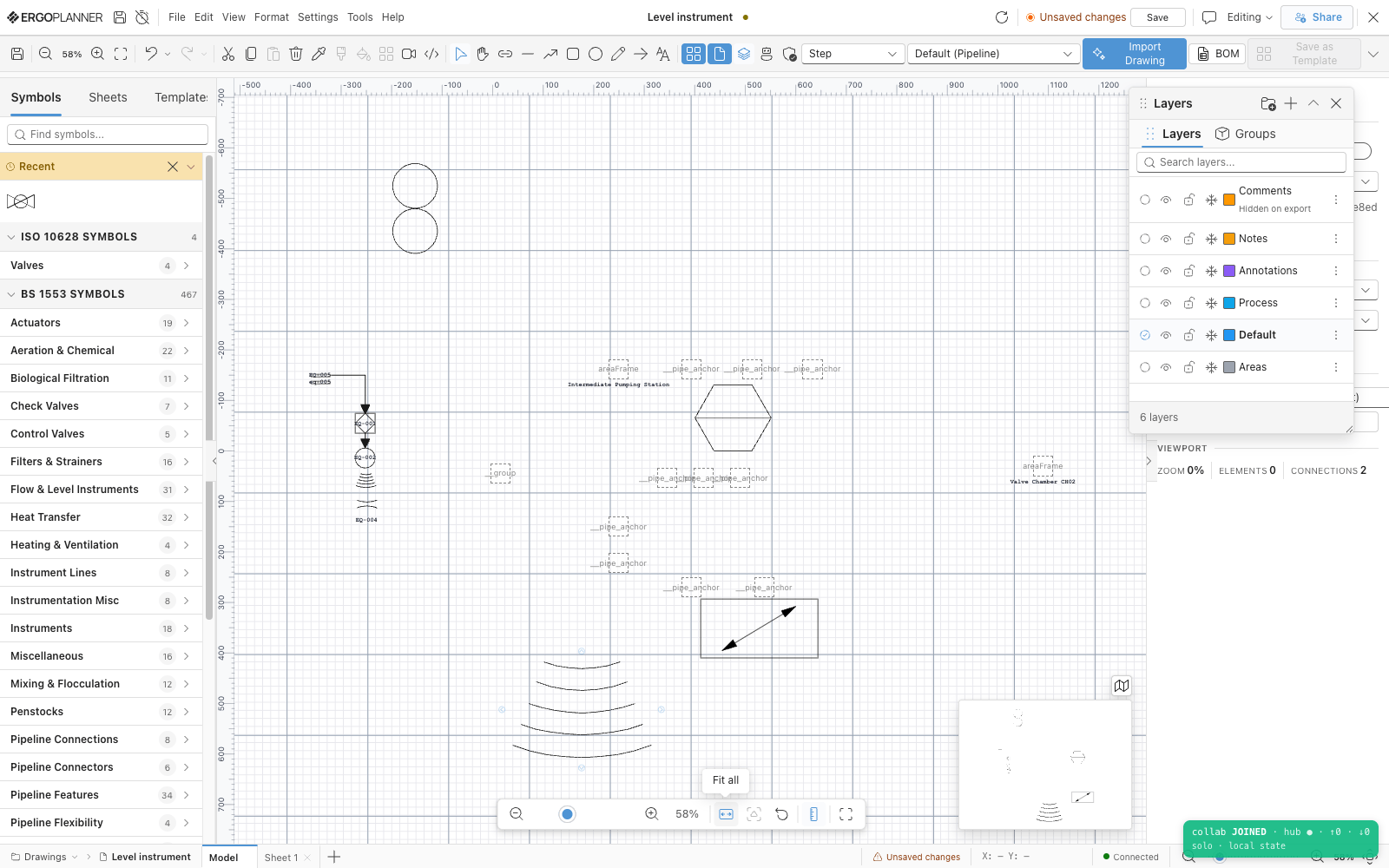
The drawing is a view of a model: a stencil rail organised by symbol standard, elements carrying their own tags on the canvas, and layers that can be hidden on export rather than erased.
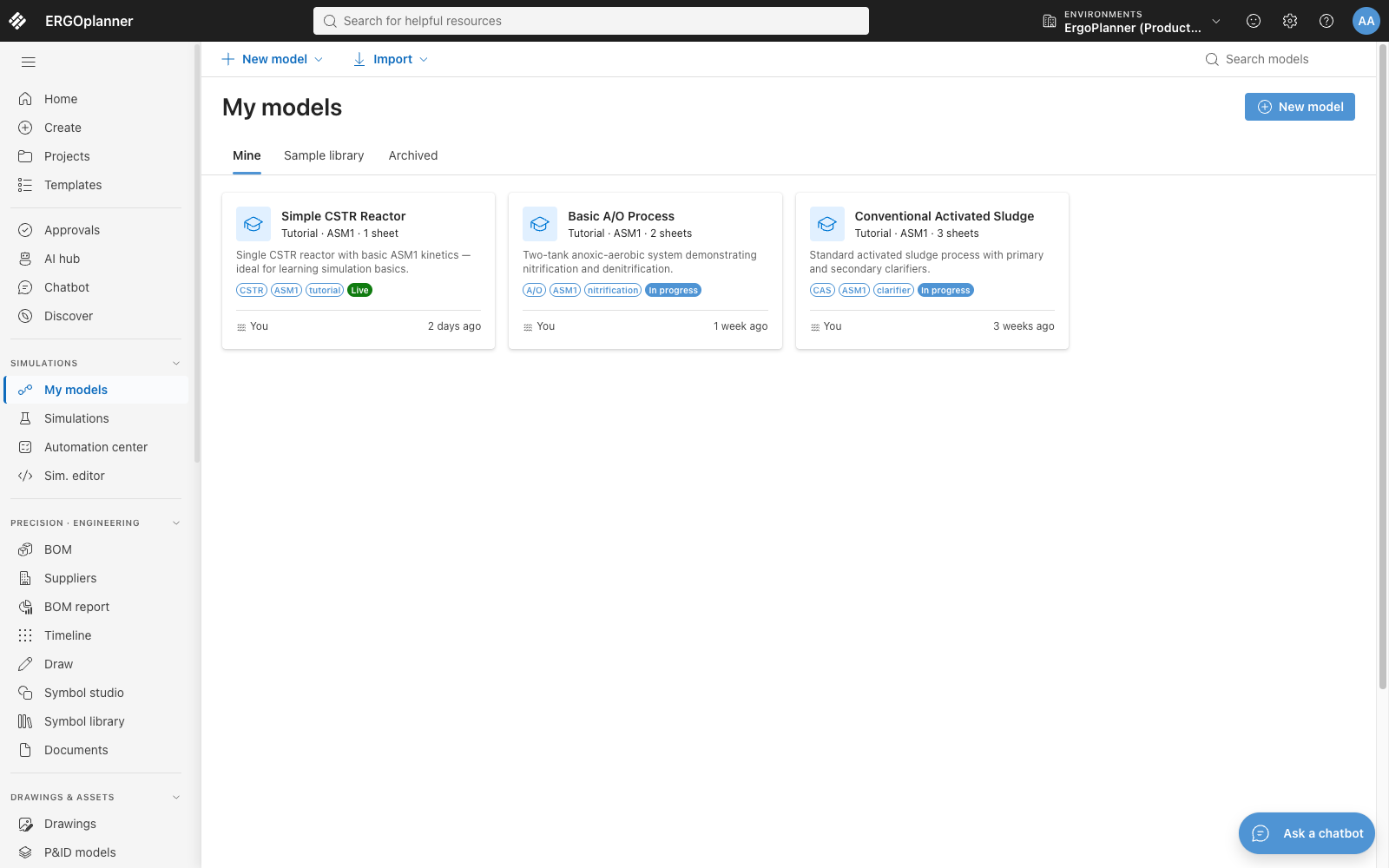
The process models that ship: a single CSTR reactor, a two-tank anoxic-aerobic process and a conventional activated sludge train, each running on the biokinetic model named on its card. This is municipal wastewater, not a general-purpose process simulator.
How we work
Three practices, each of which you can check on this site rather than take on trust.
- Every claim on this site was taken to the source before it was written, and the ones that did not survive were removed rather than softened. The security page says plainly that the database is not encrypted at rest, that no certification is held, and that backups sit unencrypted on the same host.
- Where a page is not finished, it says so on its face instead of reading as though it were. The privacy, cookie and terms pages carry a draft banner because no adviser has reviewed them, and the security page carries one because the half a buyer needs cannot be answered from source code.
- Limits are named, not discovered the hard way. Each product page names the plan, the AI provider key or the browser a capability needs, and the per-plan limits come with the quote — the price list is not published at the moment, so nor is the limit table that sits beside it.
What is not on this page
An about page is where a company is most tempted to write sentences nobody can check. These are the ones we would otherwise have written. Each is a real question, and each is waiting on a decision rather than on a paragraph.
Talk to us
A demo is the fast way to find out whether any of this fits your work. If you would rather write first — a question, a security questionnaire, a partnership — the contact form reaches the same people.